I just watched a re-run of Good Eats, "Pantry Raid IV - Comb Alone".
It was a pretty interesting introduction to how honey is made. I did not know that when bees return to the hive with their nectar they use their honey stomach to ingest and regurgitate the nectar a number of times until it is partially digested. Hence honey is born. Mmmm, bee barf - or as Alton Brown states it "bee backwash".
I found a clip on the show on YouTube, give it a watch.
Showing posts with label animals. Show all posts
Showing posts with label animals. Show all posts
24 March 2009
Comb Alone

22 March 2009
How to be a bat
I found the article and videos on Carl Zimmer's blog about how bats fly, land, and run pretty fascinating. It's the work of Brown University biologists Dan Riskin and Sharon Swartz. Check it out.
05 December 2008
Felt animal pillows
 More gift ideas coming at you all week!
Allenbrite sells a variety of felt home wares, but their felt pillows really caught my attention. They are bright and cheerful, yet true to the animal featured.
I like the furry belly on the brown bat.
Mincing Mockingbird
 While I was starting my holiday shopping/browsing, I came across The Mincing Mockingbird's shop that features very beautiful prints of birds with creative titles as well as magnets that feature birds making snarky comments.
Take a look for the bird lover or nature aficionado on your gift list.
21 November 2008
Ears and Moles
Here are two cute and biological things I saw on the Craft blog in the past two week.
First, is this star-nosed mole knitting pattern by f. pea. The star-nosed mole, Condylura cristata, spends time in and out of the water and can forage along the bottoms of streams and ponds. It uses its 22 pink nose tentacles to detect small prey, as they are functionally blind, and they can even smell underwater.
Second is a beautiful piece of embroidery of the anatomy of an ear by Crafster user weird_lover_wilde.
04 November 2008
Isopods predict McCain to win
We had lab tonight while all polls were still open on election night. We were looking at orientation behavior in isopods (also know as roly-polys or pill bugs) and what conditions they prefer.
In the spirit of the election, 2 groups of students tested if isopods prefer red light (a proxy for republican) or blue light (democrat) when given a choice. In one trial, the isopods unanimously chose the red light chamber, and in the other trial, the movement was more random, but never less than 50% of isopods were in the red chamber.
So, it looks like isopods predict a McCain victory. Watching CNN right now however, it looks like isopods may not be the best predictor of the outcome of the election.
Update to title: Isopods fail to predict election.
Go Obama!
30 September 2008
Sea creature knitting patterns
Hansigurumi has a large collection of sea creature knitting patterns for sale on her Etsy shop.
I'm partial to the anglerfish. These fish belong to the order Lophiiformes and live in the deep sea where very little light penetrates. They're named after the glowing lure they use to entice unsuspecting prey into their mouth, like an angler (fisherman) catches fish.
Also the nudibranch pattern looks a lot like their colorful real life sea slug counterparts. Nudibranch means 'naked gills' and refers to the feathery gills you see coming out of their backs.
p.s. The 100th post on this blog!
15 September 2008
Glass insect sculptures
Wow. Wesley Fleming makes very intricate insect sculptures out of glass. It was hard to pick one example pic, so check out his whole gallery here. (Via Craft)
Hercules Beetle.
Info from the artist/wikipedia:
"Native to the rain forests of Central and South America, their title is well deserved as they are one of the largest beetles known. This scarab beetle is most noted for its thoracic and cephalic horns, which can grow longer than the body of the beetle itself. This adaptation is primarily used during fights with other males.
The Hercules beetle is said to be the strongest creature on earth for its size, able to carry 80 times its own body weight."
04 September 2008
Seafood Watch
 The Monterey Bay Aquarium, in addition to being my favorite aquarium, publishes a pocket guide called Seafood Watch to help consumers choose sustainable seafood.
"[Seafood Watch is] a program of Monterey Bay Aquarium designed to raise consumer awareness about the importance of buying seafood from sustainable sources. We recommend which seafood to buy or avoid, helping consumers to become advocates for environmentally friendly seafood."They have guides for various regions in the United States, and while I was over on their website to download a newer guide, I saw you can now browse to the guide on your cell phone. Just log on to mobile.seafoodwatch.org and you'll be automatically directed to the latest online pocket guide.
Technology is cool.
27 August 2008
Cows face north-south
You might have heard the saying that moss mainly grows on the north side of trees. That "rule" is generally only true in the northern latitudes and dependent on the area's ambient light and moisture. But here's a new orientation rule in case you get lost, cows and deer tend to face magnetic north or south when grazing and resting.
I'm amazed at how people use Google applications these days, and in the case of this study German and Czech researchers examined over 8000 cows and almost 3000 deer satellite images using Google Earth. Researchers have previously shown that many animals have a magnetic sense, from fruit flies, birds, amphibians and fish. However, this is the first report of large mammals sensing magnetic fields.
For a more in depth summary, check out Scientific American's article here, or if you're not up to reading, they have a 60 second podcast too.
23 August 2008
Shearwater
 I just read a really interesting interview with Jonathan Meiburg, a singer/songwriter in the band Shearwater, over at Scientific American.
I am always on the look out for songs that incorporate biology and there are many songs the mention birds. But in this case, birds are a common theme in Shearwater's songs because Meiburg is also an ornithologist and got a master's degree studying the biogeography of the Striated Caracara. Looking for the band's website, I also learned even the band's name is bird related, shearwaters are long winged seabirds.
You can listen to several Shearwater songs online at the band's website and also on last.fm.
Squid hats
 I just saw these cute plush squid hats on ObeyMyBrain's Etsy shop. If I wasn't a poor graduate student, I'd buy one and go as a giant squid for Halloween. Or maybe a ship being attacked by a kraken.
I think PZ would like these.
10 August 2008
We Climb
I'm really enjoying the July song over at The Guild of Scientific Troubadours. It's called "We Climb" and it's about Ventastega curonica, a transitional fossil between fish and tetrapods. In case you missed it, check out the song and the article its based on over on Grant's site.
17 July 2008
Platypus Tee
The genome of the platypus (Ornithorhynchus anatinus) was published in May of this year and made quite the stir in the news (here and here for example) as it seems they've found genes shared by reptiles, birds, and mammals. I just saw this tee over at Snorgtees.com - a tribute to the platypus genome and crime fighting cartoons.
18 May 2008
Green Porno Online
 I blogged previously about Green Porno, a new series of short films, starring Isabella Rossellini, about insects (also a worm, snail) and how they copulate. Sundance now has them all online, go here to check them out. I haven't watched them all yet, but "Earthworm" and "Bee" are pretty fascinating and a little disturbing all at the same time. In other words, they're awesome.
On a rainy Sunday afternoon
Here are two things to check out on this gloomy Sunday courtesy of the Craft Magazine Blog.
Fold away your troubles and make a origami lily, the step by step directions can be found here.
Also take a look at these neat robot animals made from recycled electronic parts. The artist, Ann Smith, has a whole gallery of animals over on her website.
26 March 2008
Elephants Filming Tigers
I am always amazed at how smart animals are.
The BBC is airing a series called "Tiger - Spy in the Jungle" and in order to get good close up shots of secretive tigers, they trained elephants to carry cameras. Humans have trained elephants to do many tasks, but camera wielding is a new one on me. They also had motion sensing cameras set up to look like rocks and logs. Again, the animals were smart and were totally not fooled, you can watch videos of animals (tigers and monkeys) investigating the cameras over here.
This is set to air on BBC One this week, but I really hope this makes it to American TV as well. David Attenborough and tigers and elephants, oh my.
12 March 2008
T. rex ate giant melons
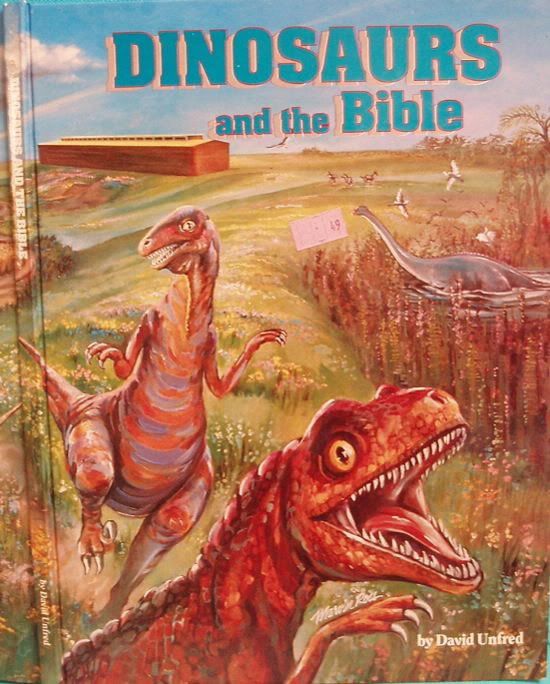
"Dinosaurs! Children love them, but all too often stories about dinosaurs are used to lure young people away from confidence in the Bible."The book tries to deny evolution and geology and instead asserts that
"There is only one way that we can know anything for sure about the 'prehistoric' past - from an eyewitness account! Someone who was there has to tell us what happened. God, Himself, is our best eyewitness."For those of you who learned about dinosaurs scientifically and are curious, the following is what kids are learning about dinosaurs from this book and I guess also from the Bible. Dinosaurs were made on the sixth day, along with all other land animals. Two of each kind of dinosaur were on Noah's ark during the flood (how they all fit is beyond me). All the fossils we see today were deposited during this flood. Dinosaurs, once disembarking the ark, might have then died due to cold weather, lack of food, and hunting by people. Continental drift doesn't occur, and the reason we see dino fossils in polar areas is just because the earth was a lot warmer before the flood. Dinosaurs and people lived at the same time and that's why we have stories about dragons. If you wanted to find a living dinosaur today, the African Congo seems to be the place to look as there have been sightings of dino-like creatures.
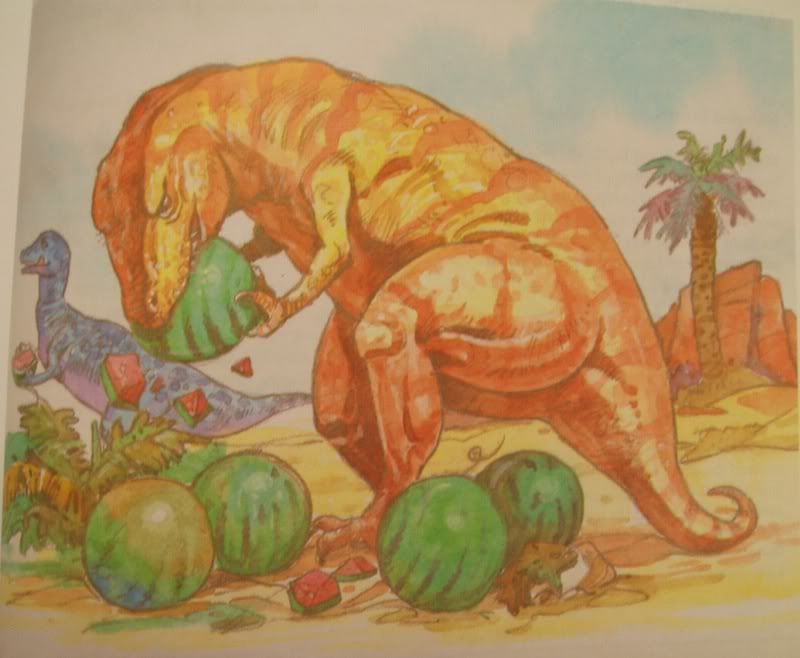 My favorite assertion, because it's just so ridiculous, is in Appendix A. In it the author claims that since in the Garden of Eden all the animals ate plants that means that dinosaurs, even Tyrannosaurus rex were vegetarians (at least in the beginning). This claim comes with a hilarious illustration of T. rex chomping down on a giant watermelon clutched in his tiny arms. While there might be some debate over if T. rex was a pure predator or scavenger, I don't think any scientist would ever say the T. rex was adapted to eating melons. And if all animals started eating plants does that mean meat eating animals that we see today have adapted and even evolved to eat meat? Blasphemous!
There is so much wrong with this book, and so much glossed over because there is no biblical explanation, it is just so funny. I could go on for a long time, but in summary to refute the points above scientifically: Dinosaurs roamed the Earth from the late Triassic (about 230 million years ago) to the end of the Cretaceous period (65 million years ago) and all, except for ancestors of modern birds and reptiles, died in the Cretaceous-Tertiary extinction event. One flood like event could not account for the layers of fossils of various ages that we find. Dinosaur evolution responded to changes in vegetation and the location of continents. In the late Triassic and early Jurassic, the continents were connected as the single landmass Pangea and by the early Cretaceous the ongoing breakup of Pangea led to dinosaurs differentiated by landmass. The first members of the genus Homo first arose about 2.5 million years ago, long after dinosaurs were extinct.
The best $0.49 I've spent for laughs and also to prevent others from buying and believing its claims. It's too bad I don't believe these bible stories, riding a melon eating T. rex would be a lot of fun.
19 February 2008
Cute as a Button
 I hadn't been reading Cute Overload lately, but I checked in again recently to fawn over the adorable animals. This of course led to the question, why do humans think baby animals (especially mammals) are cute?
(photos to the right taken from Cute Overload)
Well, Cute Overload has made a list of what makes animal pictures cute (the Rules of Cuteness), and I think two of their rules in particular pertain to why, as humans, we find them so adorable. Rule #2 is "Look helpless" and rule #6 is "Mimic humans". It seems that since human babies are helpless when born, humans have been wired to respond to and help things that look infantile (like round faces, forward facing eyes, round ears, and floppy limbs to name a few). There was an interesting article titled The Cute Factor, published in the New York Times in 2006, that had this to say about cute animals:
"The human cuteness detector is set at such a low bar, researchers said, that it sweeps in and deems cute practically anything remotely resembling a human baby or a part thereof, and so ends up including the young of virtually every mammalian species, fuzzy-headed birds like Japanese cranes, woolly bear caterpillars, a bobbing balloon, a big round rock stacked on a smaller rock, a colon, a hyphen and a close parenthesis typed in succession....
Madison Avenue may adapt its strategies for maximal tweaking of our inherent baby radar, but babies themselves, evolutionary scientists say, did not really evolve to be cute. Instead, most of their salient qualities stem from the demands of human anatomy and the human brain, and became appealing to a potential caretaker's eye only because infants wouldn't survive otherwise.
Human babies have unusually large heads because humans have unusually large brains. Their heads are round because their brains continue to grow throughout the first months of life, and the plates of the skull stay flexible and unfused to accommodate the development. Baby eyes and ears are situated comparatively far down the face and skull, and only later migrate upward in proportion to the development of bones in the cheek and jaw areas.
Baby eyes are also notably forward-facing, the binocular vision a likely legacy of our tree-dwelling ancestry, and all our favorite Disney characters also sport forward-facing eyes, including the ducks and mice, species that in reality have eyes on the sides of their heads.
The cartilage tissue in an infant's nose is comparatively soft and undeveloped, which is why most babies have button noses. Baby skin sits relatively loose on the body, rather than being taut, the better to stretch for growth spurts to come, said Paul H. Morris, an evolutionary scientist at the University of Portsmouth in England; that lax packaging accentuates the overall roundness of form.
Baby movements are notably clumsy, an amusing combination of jerky and delayed, because learning to coordinate the body's many bilateral sets of large and fine muscle groups requires years of practice. On starting to walk, toddlers struggle continuously to balance themselves between left foot and right, and so the toddler gait consists as much of lateral movement as of any forward momentum."
 Advertisers understand our reaction to all things cute. This is especially true in Japan, where the concept of kawaii (cuteness) pervades many things from products to governmental warnings. Any one who has been a girl or is raising girls understands the immense draw of Sanrio characters like Hello Kitty. The oddest example that I have seen of making objects cute is kawaii poo.
So, no need to be ashamed at your love of baby animals. It's in our nature to want to cuddle and protect them.
11 February 2008
Tapeworms and Polar Bears
 So, I decided to play voyeur yesterday and spent some time looking at how people arrived at this blog via my Sitemeter.
One search caught my attention, and it appears that Cells in Culture ranks number one on Google for the search: tapeworms and polar bears. In honor of this, I made the logo to the right.
So hurray, I have an entry in case the "Number one on Google" meme makes it's way across the internet again. This blog also ranks number one for "liverwort sperm" but that's harder for me to make into a cartoon.
Subscribe to:
Posts (Atom)


